





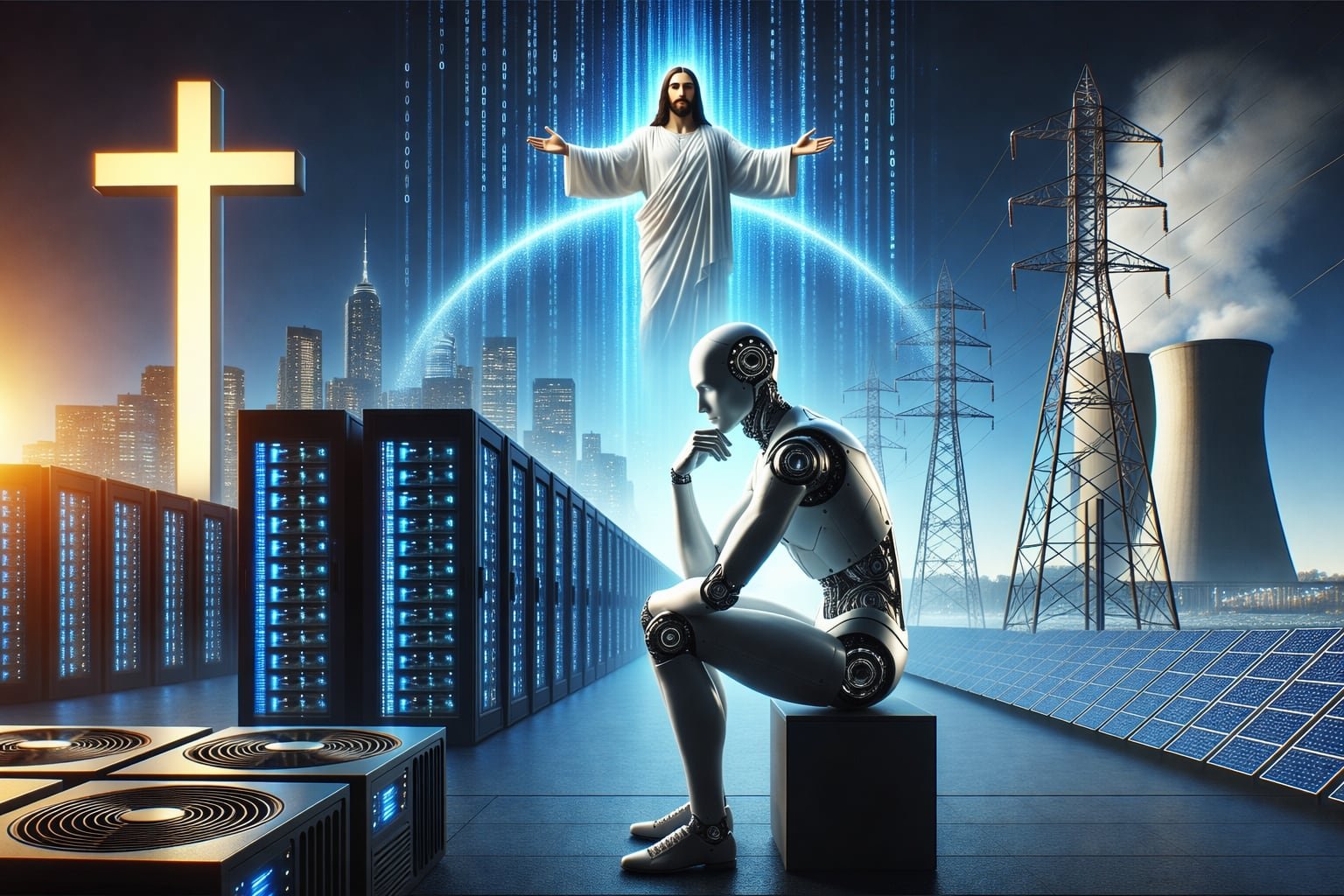

I read carefully Sam Altman’s remarks at the India AI Impact Summit 2026, where he addressed growing concerns about the environmental impact of artificial intelligence. He dismissed viral claims suggesting that each ChatGPT query consumes massive amounts of water or electricity, calling many of those numbers “totally false.” He also introduced a provocative comparison: that training a human being cognitively over a lifetime requires significant energy as well, perhaps more than what powers large AI models.
Part of what he said is technically reasonable. Public debate around AI energy consumption has often relied on exaggerated or decontextualized figures. Data centers have improved efficiency, and cooling technologies have evolved significantly. But even if the viral statistics are inflated, the deeper question remains untouched. The issue is not simply whether the numbers are accurate. The issue is whether we are asking the right moral question at all.
The Question Is Not Only Technical – It Is Moral
Altman is correct that some online claims lack nuance. Modern data centers are more efficient than their early predecessors. Water usage varies widely depending on cooling architecture and geography. Energy intensity per query fluctuates depending on the model and hardware generation. These are technical realities.
But efficiency does not equal moral legitimacy. A system can become more efficient while expanding so rapidly that its total footprint increases dramatically. Altman himself acknowledged that overall AI energy consumption is growing quickly and that renewable sources like nuclear, solar, and wind are essential to mitigate environmental impact. That admission is important. Yet it does not answer the deeper question: toward what end is this energy being directed?
The Church has consistently taught that technological progress is not identical with authentic human progress.
The Second Vatican Council stated:
“Scientific and technical progress… must be ordered to the true good of humanity.” (Gaudium et Spes, 35)
Energy consumption is not neutral. It is civilizational. Every gigawatt deployed toward infrastructure reflects a value judgment about what kind of society we are building.
Comparing Humans to Algorithms: A Dangerous Analogy
When Altman suggested that “it also takes a lot of energy to train a human,” he introduced an analogy that reveals more than it clarifies. From a strictly material standpoint, it is true: human development requires decades of caloric intake, housing, transportation, education, and infrastructure. But reducing the formation of a human being to an energy equation exposes a deeply utilitarian framework.
The human person is not an energy-processing unit.
The Catechism of the Catholic Church teaches:
“The human person is the only creature on earth that God has willed for its own sake.” (CCC 356)
Human cognitive development is not comparable to GPU training cycles. It is rooted in freedom, consciousness, relationality, and the image of God. When we begin to frame intelligence in terms of energy efficiency, we subtly risk framing humanity itself in terms of efficiency. Once value is quantified primarily through input-output metrics, dignity becomes vulnerable.
The danger is not the analogy itself. The danger is the anthropological reductionism it implies.
Dominion Over Creation Is Not Technocratic Control
Altman emphasized that renewable energy must power AI infrastructure. That is a positive acknowledgment. The Church does not reject technological development nor advocate primitivism. What it insists upon is moral integration.
Saint John Paul II warned that human dominion over creation must be stewardship, not exploitation. Pope Francis expanded this teaching in Laudato Si’, articulating the concept of integral ecology — a vision that connects environmental, social, and moral dimensions.
“The technological paradigm tends to dominate economic and political life.” (Laudato Si’, 109)
“The human environment and the natural environment deteriorate together.” (Laudato Si’, 48)
The environmental debate surrounding AI cannot be isolated from the broader technocratic paradigm. It is not enough to switch energy sources if the underlying logic remains expansion without limits, optimization without meaning, scale without discernment.
Exponential Growth and the Absence of Moral Limits
The most concerning aspect of AI development is not that it consumes energy. All human activity does. The real concern is exponential scaling combined with insufficient moral deliberation. We are witnessing the rapid consolidation of cognitive infrastructure in the hands of a small number of actors, operating within a global competitive race framed as inevitable.
Benedict XVI warned about precisely this dynamic:
“Technology tends to absorb everything into its own logic.” (Caritas in Veritate, 70)
When technological capability becomes the primary measure of legitimacy, ethical reflection becomes secondary. The logic becomes simple: if it can be built, it will be built. If it can be scaled, it will be scaled. If it can replace human labor or cognition, it will do so.
Energy debates, in this context, are surface-level disputes about efficiency within a deeper framework that rarely questions whether the trajectory itself is ordered toward the true good of the human person.
Efficiency Is Not the Final Measure of Civilization
Even if AI models were to become extraordinarily energy efficient, the moral question would remain unchanged. What is this intelligence serving? Is it oriented toward truth or manipulation? Toward human flourishing or attention capture? Toward solidarity or monopolistic concentration of power?
The Church reminds us that the ultimate destiny of the human person is communion with God, not technological optimization.
“For without the Creator the creature vanishes.” (Gaudium et Spes, 36)
A civilization that masters data but loses transcendence does not advance; it destabilizes itself. A society that can generate synthetic cognition at scale but cannot articulate the moral purpose of that cognition risks building immense infrastructure without an anchoring vision of the good.
The Real Debate Has Not Yet Begun
Altman is correct that exaggerated environmental claims distort public discourse. Transparency and accuracy matter. But the deeper debate has not yet begun. The central issue is not whether a query consumes X or Y units of water. The central issue is whether our technological expansion is subordinated to the dignity of the human person and the common good.
Energy fuels more than servers. It fuels civilizational direction.
We can direct technological power toward authentic human development, or we can allow the technocratic paradigm to redefine humanity itself. That choice is not technical. It is moral.
And unless moral reasoning grows as rapidly as computational capacity, the environmental footprint of AI may turn out to be the least of our concerns.
Sources
- Times of India — Coverage of Sam Altman’s remarks at the India AI Impact Summit 2026.
- The Guardian — Reporting on Altman’s comparison between AI energy use and human development.
- Business Insider — Discussion of claims about ChatGPT energy consumption.
- TechRound — Coverage of Altman denying high water-use allegations.
- TechCrunch — Commentary on AI infrastructure energy demands.
- Second Vatican Council, Gaudium et Spes.
- Catechism of the Catholic Church.
- Benedict XVI, Caritas in Veritate.
- Pope Francis, Laudato Si’.