





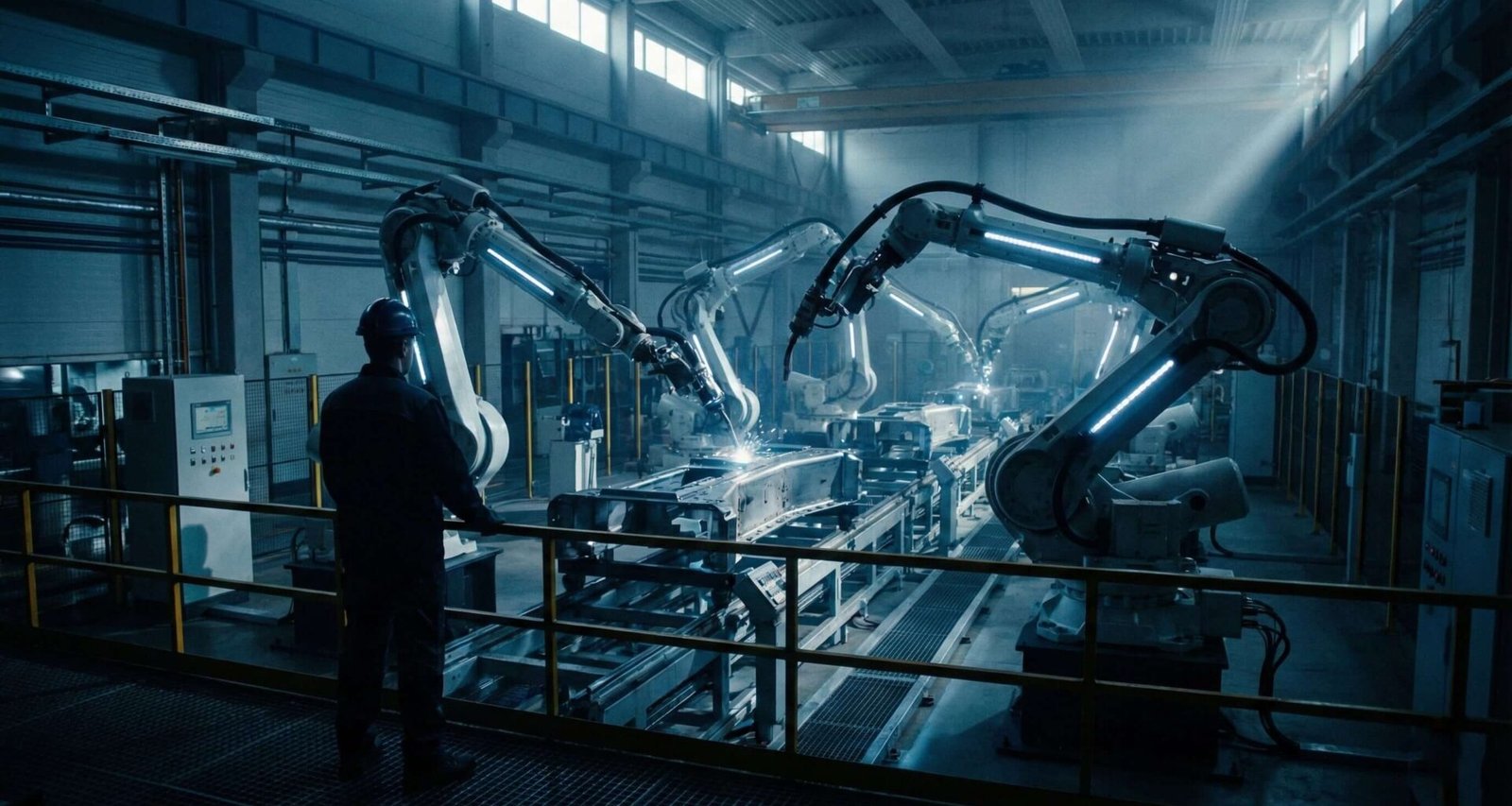

The Silent Transformation of Work
Artificial intelligence and advanced automation are not merely optimising processes — they are reshaping the structure of human labour itself.
The Fourth Industrial Revolution is defined not only by technological innovation, but by a profound reconfiguration of production, employment and capital distribution.
The central question is no longer whether automation will increase productivity. The structural question is:
Who will capture the value generated by that productivity?

From Mechanisation to Cognitive Automation
Previous industrial revolutions transformed physical labour. Mechanisation replaced muscle power; electrification reorganised factories; computing digitised workflows.
The current technological shift introduces a qualitative change: cognitive automation.
Artificial intelligence systems can now:
- Draft complex reports
- Analyse large datasets
- Generate creative content
- Optimise business decisions
- Replace administrative and knowledge-based tasks
This means sectors once considered protected by education and professional training are no longer immune to disruption.
Automation has moved beyond the factory floor into the cognitive core of the economy.
Productivity and the Distribution Paradox
Historically, productivity gains tended to increase overall living standards. However, the link between productivity growth and wage growth has weakened in recent decades.
AI-driven automation often:
- Reduces labour costs
- Increases corporate margins
- Scales operations with fewer employees
When the technological infrastructure is controlled by a small number of global corporations, a significant share of the generated value accumulates within those entities.
This creates a paradox:
Higher productivity does not automatically translate into broader income distribution.
Capital Concentration and the New Technological Elite
Companies that control:
- Cloud infrastructure
- Foundational AI models
- Semiconductor design and manufacturing
- Global data platforms
possess structural advantages that are difficult to replicate.
Artificial intelligence operates with strong network effects and economies of scale. The more data and computational capacity a firm commands, the greater its competitive edge.
This dynamic favours consolidation.
A new technological elite emerges — not merely dominating markets, but influencing:
- Information ecosystems
- Public narratives
- Research agendas
- Indirect political decision-making
The Fourth Industrial Revolution does not inherently decentralise power. It may, in fact, intensify concentration.
The Future of Employment: Substitution, Transformation and Polarisation
Automation does not eliminate all jobs. It transforms their composition.
Three simultaneous trends can be observed:
- Substitution of routine tasks
- Creation of highly specialised roles
- Growing polarisation between high-income and low-income employment
Mid-skill occupations — administrative roles, routine analysis, repetitive office work — face increasing vulnerability.
Without structural adaptation, income inequality and social tension may widen.
Europe and the Strategic Challenge
In the European and UK context, automation intersects with:
- Ageing populations
- Strong welfare systems
- Regulated labour markets
- Technological dependence on external infrastructure
Two strategic questions arise:
Can Europe leverage automation to sustain productivity amid demographic decline?
Or will it become structurally dependent on AI infrastructure developed elsewhere?
The answer depends on:
- Investment in technical education
- Domestic innovation capacity
- Digital infrastructure resilience
- Coherent industrial policy
Automation is not simply a corporate matter. It is a regional competitiveness issue.
Automation as Structural Power
Artificial intelligence is not just a business tool. It is a structural layer of the modern economy.
Those who control:
- Model development
- Training infrastructure
- Data centres
- Platform distribution
control significant portions of digital economic flows.
Automation thus becomes a question of structural power.
This is not merely about efficiency. It is about economic architecture.
Toward Algorithmic Capitalism?
The combination of:
- Highly concentrated capital
- Centralised digital infrastructure
- Cognitive automation
may consolidate a form of algorithmic capitalism in which economic value is increasingly generated by automated systems operated by highly technological corporations.
In such a scenario, the challenge is not to halt innovation, but to ensure that transformation does not erode social cohesion or long-term economic stability.
Conclusion: The Real Debate
Public discussion around artificial intelligence often focuses on spectacular breakthroughs or existential risk. Yet the most immediate transformation is economic.
The Fourth Industrial Revolution redefines:
- The relationship between labour and capital
- Income distribution
- Corporate power structures
- Regional economic autonomy
Automation is not neutral.
It is a vector of structural transformation.
And the decisive question is not whether artificial intelligence will increase productivity.
The decisive question is who will control the value that productivity generates.