




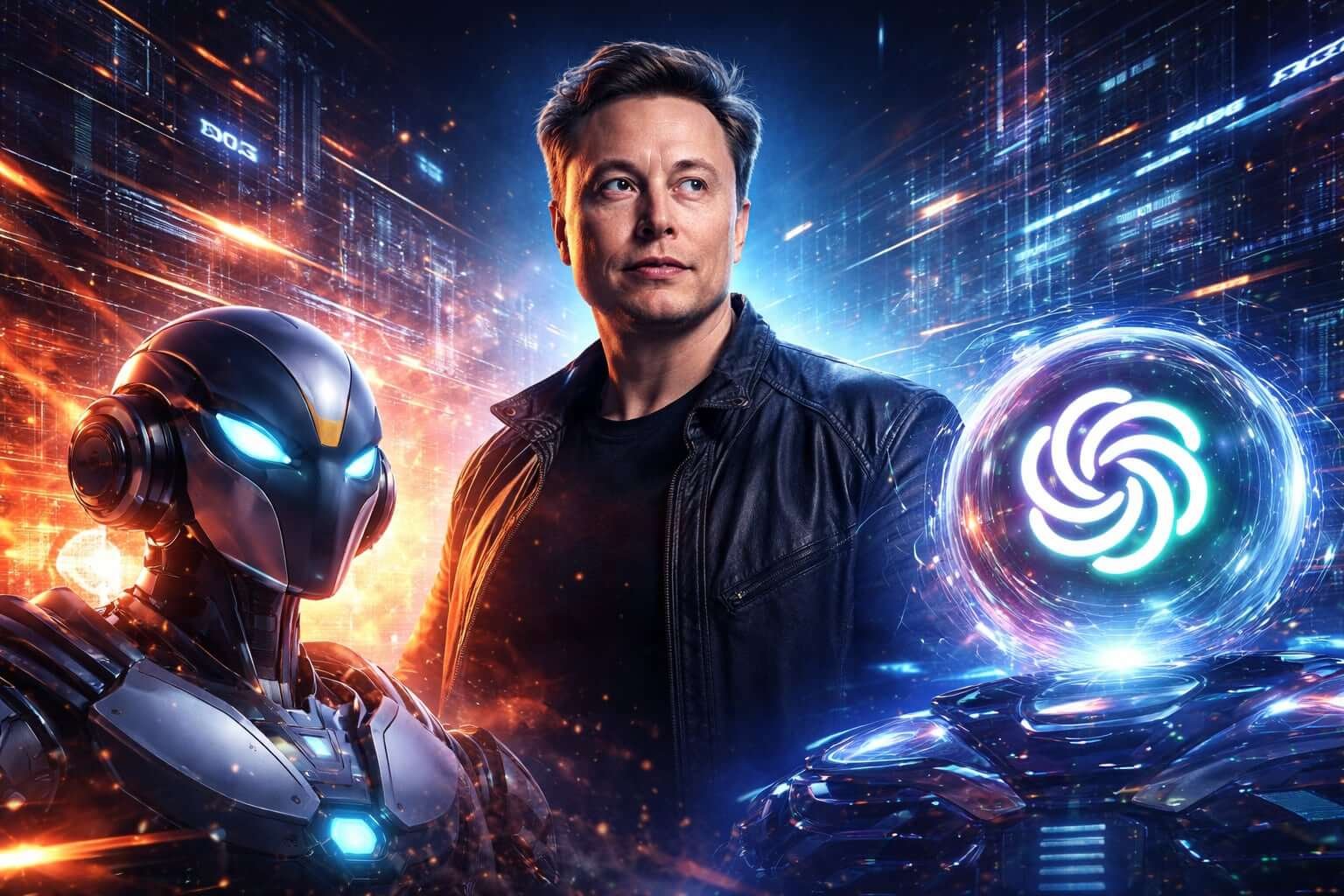

A new player has officially entered the artificial intelligence battlefield — and it is not just another chatbot.
xAI, founded by Elon Musk, has launched Grok, a conversational AI model positioned as a direct challenger to ChatGPT, developed by OpenAI.
But this is not merely a product launch.
It may represent a structural shift in how artificial intelligence, social media, and algorithmic power converge.
What Is Grok — and Why Does It Matter?
Grok was introduced as a chatbot inspired by The Hitchhiker’s Guide to the Galaxy, designed to respond with humor, wit, and a less politically constrained tone than many existing AI systems.
However, personality is not its most important feature.
Its true strategic advantage lies in real-time integration with X (formerly Twitter).
Unlike traditional large language models that rely primarily on pre-trained datasets and periodic updates, Grok is connected directly to the live data stream of X. That means it can process ongoing conversations, trends, and user behavior as they happen.
In simplified terms:
- ChatGPT processes structured knowledge.
- Grok processes live conversation at scale.
That difference is not cosmetic — it is architectural.
Vertical Integration: The Musk Strategy
What makes Grok especially significant is not just its technical design but its ownership structure.
Elon Musk controls:
- X (the social platform generating the data)
- xAI (the company building the model)
- The infrastructure layer that supports both
This level of vertical integration is rare in the AI industry.
While Microsoft supports OpenAI and Google develops its own AI systems, Musk is attempting something different: embedding artificial intelligence directly into the core algorithm of a major social platform.
If successful, this could mean a transition from traditional engagement-based ranking systems (likes, shares, comments) toward neural-network-driven prediction models that anticipate user behavior.
Not recommendation.
Prediction.
That shift would fundamentally alter the dynamics of digital influence.
Access and Monetization: Intelligence as a Premium Layer
Currently, Grok is available only to subscribers of X Premium Plus.
This raises two important questions:
- Is advanced AI becoming a subscription-based cognitive advantage?
- Will access to superior AI tools become economically stratified?
In the Fourth Industrial Revolution, intelligence is no longer just human capital — it is augmented capital.
If access is tiered, then cognitive leverage becomes a monetized privilege.
Beyond a Chatbot: Building a Unified AI Ecosystem
The creation of xAI is not isolated from Musk’s broader technological ecosystem.
It intersects with:
- Tesla
- Neuralink
- Starlink
- X
The long-term vision appears to be the development of an interconnected technological architecture in which AI functions as the cognitive core.
If xAI becomes the central intelligence layer across these ventures, Musk would not simply own platforms or hardware.
He would own the decision-making layer embedded within them.
That is a different scale of power.
The Paradox of Risk
In public conversations — including discussions with figures such as Rishi Sunak — Musk has openly acknowledged the risks associated with advanced artificial intelligence.
He has referenced concerns about autonomous systems evolving beyond predictable control.
Yet simultaneously, he continues accelerating AI development within his own ecosystem.
This paradox defines our moment:
The same actors warning about AI’s dangers are also racing to dominate its architecture.
Is This the End of ChatGPT?
Not at all — at least not yet.
ChatGPT maintains significant advantages:
- Enterprise partnerships
- Institutional adoption
- A mature developer ecosystem
- Broad global usage
However, Grok introduces something structurally new: the fusion of real-time social data, conversational AI, and algorithmic governance within a single corporate entity.
That combination could reshape how information flows — and who controls it.
The Real Battle: Control of the Social Algorithm
The emergence of Grok is not simply about conversational capability.
It is about control over the algorithmic layer that determines visibility, influence, and digital perception.
In the coming years, the decisive question will not be:
Which chatbot writes better answers?
It will be:
Who controls the neural infrastructure that shapes collective attention?
The Fourth Industrial Revolution is not defined by apps.
It is defined by the ownership of cognitive infrastructure.
And Grok may be the first visible move in that larger strategic game.