





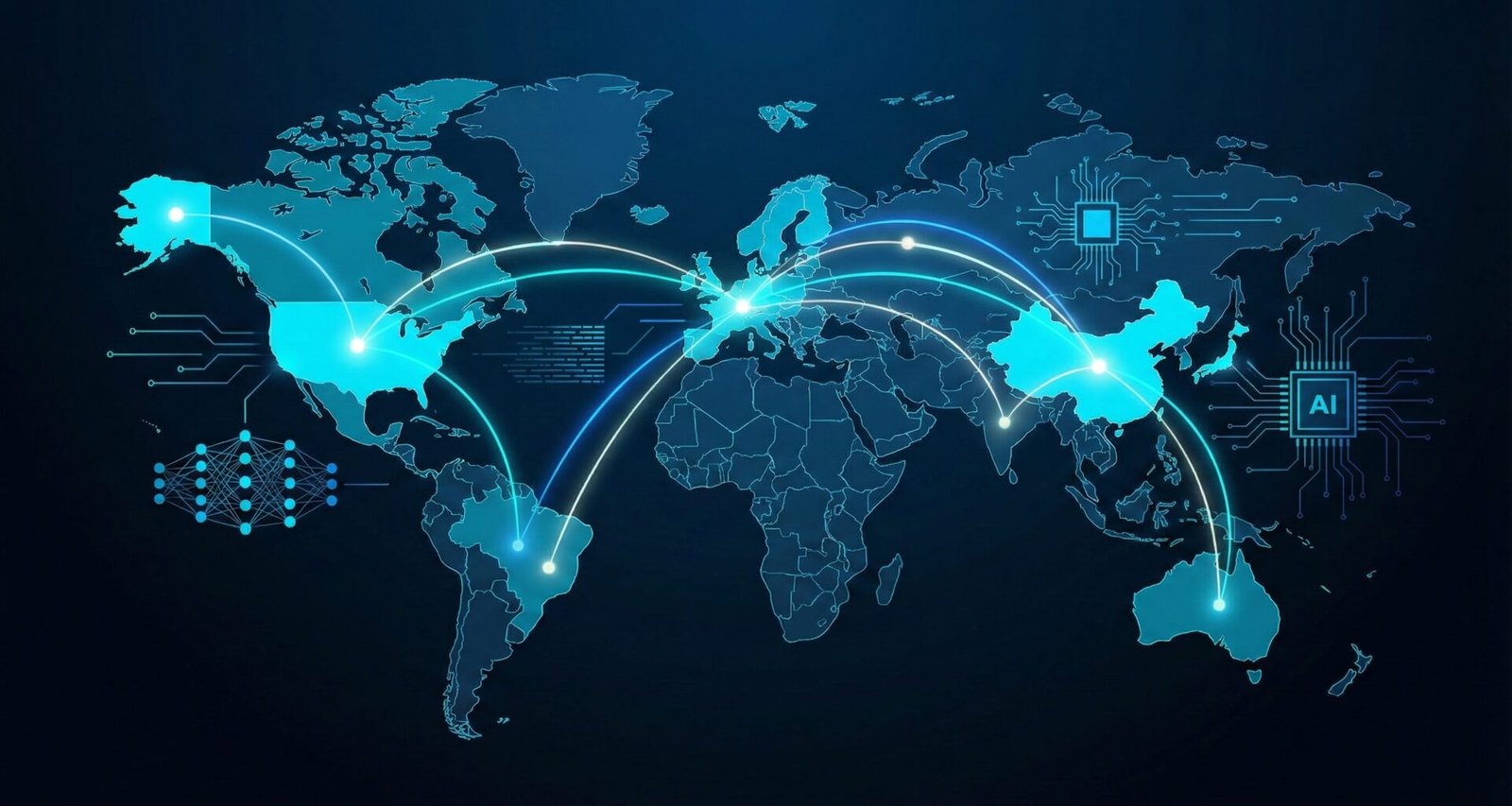

AI as an Instrument of Power
Artificial intelligence is no longer merely a technological tool. It has become a strategic instrument of economic, political and military power. The global competition for AI leadership increasingly resembles the space race of the twentieth century — but with far deeper implications. This is not only about innovation; it is about control over data, computational infrastructure, productivity systems and the architecture of the digital future.
The United States, China and Europe are not simply competing to build better models. They are competing to define the rules, standards and power structures of technological civilisation in the twenty-first century.
The key question is no longer who builds the most advanced model — but who controls the infrastructure that makes artificial intelligence possible.
The United States: Private Innovation and Capital Concentration
The United States currently leads the development of frontier AI systems. Companies such as OpenAI, Google DeepMind, Anthropic and Meta concentrate talent, capital and computational resources at an unprecedented scale.
Unlike traditional state-led industrial strategies, American AI leadership is largely driven by private corporations. Venture capital, strategic alliances and hyperscale cloud providers shape the rhythm of innovation. The partnership between OpenAI and Microsoft, for example, illustrates how infrastructure, capital and advanced research increasingly converge.
This model produces two structural consequences:
- Massive capital concentration within a handful of technology firms.
- Public dependence on privately controlled AI infrastructure.
Although innovation is corporate-led, the strategic dimension cannot be ignored. U.S. defence institutions closely monitor and integrate AI development into national security planning. Artificial intelligence has become embedded in the broader logic of geopolitical competition.
China: State Coordination and Technological Sovereignty
China approaches artificial intelligence through a different paradigm. AI development is integrated into long-term national planning frameworks, with clear objectives related to technological sovereignty and global leadership.
The Chinese strategy includes:
- Domestic semiconductor development.
- Large-scale data infrastructure.
- Integration of AI into manufacturing, logistics and surveillance.
- Military applications.
Whereas the American model is market-driven, China’s AI ecosystem reflects coordinated state involvement. The objective extends beyond commercial competitiveness. It is about reducing technological dependence and securing digital autonomy.
In this context, artificial intelligence becomes not merely an industry, but a pillar of national strategy.
Europe and the United Kingdom: Regulation as Strategy
Europe and the United Kingdom face a structurally different position. They do not dominate foundational model development nor semiconductor production at the scale of the United States or East Asia. Instead, they aim to lead in regulatory architecture.
The European approach emphasises:
- Data protection.
- Risk mitigation.
- Ethical oversight.
- Algorithmic transparency.
The EU AI Act represents one of the most comprehensive regulatory frameworks globally. Its ambition is clear: establish standards that could shape international norms before technological expansion outpaces governance.
However, this strategy carries tension.
Can a region effectively regulate a technology it does not fully control?
If regulatory ambition exceeds technological capacity, Europe risks strategic dependency. Yet if regulation is balanced with innovation support, Europe could shape the normative framework of global AI development.
Semiconductors: The Physical Foundation of AI Power
The AI race is not won solely by software innovation. It is fundamentally constrained by computational capacity.
Advanced semiconductors are the critical bottleneck of large-scale AI systems. Companies such as NVIDIA have become central actors in the global balance of technological power. Control over chip design, fabrication and export restrictions directly influences geopolitical leverage.
Semiconductor supply chains reveal deeper vulnerabilities:
- Dependence on Taiwan’s manufacturing capacity.
- Export controls targeting China.
- Massive industrial investments in domestic chip production across the United States and Europe.
Artificial intelligence ultimately depends on physical infrastructure. The digital future rests on silicon.
AI and the Reshaping of Global Order
Artificial intelligence is restructuring multiple dimensions of global power:
- Economic productivity.
- Military capability.
- Information control.
- Cultural influence.
The ability to design, train and deploy advanced AI systems confers advantages that extend beyond market competition. It shapes strategic autonomy and international influence.
This is not merely a technological transition. It is a transformation of the architecture of power itself.
Toward Technological Fragmentation?
The most plausible medium-term scenario is not universal convergence but technological fragmentation.
We may witness:
- A U.S.-led ecosystem centred on private innovation and allied networks.
- A Chinese ecosystem built around state-coordinated technological sovereignty.
- A European framework attempting to influence global norms through regulation.
Diverging standards, trade restrictions and strategic competition may define the next phase of the global AI landscape.
Artificial intelligence is emerging as the structural axis of twenty-first-century geopolitics.
Conclusion: Beyond Technological Enthusiasm
Public discourse often frames artificial intelligence as inevitable progress. Yet behind each breakthrough lies strategic positioning, capital concentration and political decision-making.
The global AI race is not primarily about efficiency or convenience. It is about who defines the rules of the digital order.
Artificial intelligence is no longer just an innovation sector. It is a civilisational variable.
And the competition for its control will shape the future of global power.