





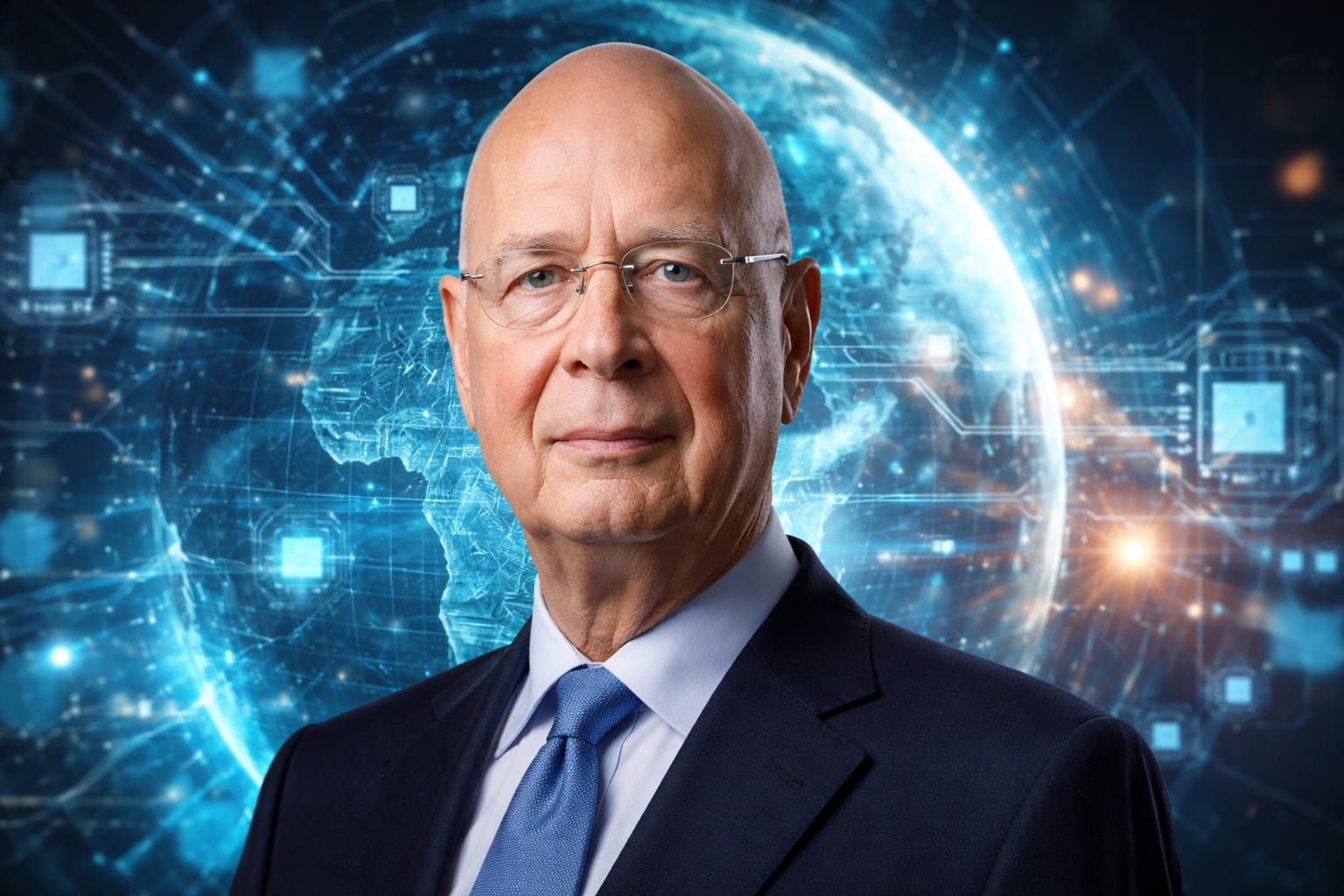

From the eighteenth to the twentieth century, humanity experienced three major industrial revolutions: mechanization powered by steam, electrification and mass production, and the digital revolution driven by computing and telecommunications. Today, according to dominant global economic and technological discourse, we are entering a fourth stage: the so-called Fourth Industrial Revolution, a concept popularized by Klaus Schwab, founder and executive chairman of the World Economic Forum.
Schwab articulated this framework in his book The Fourth Industrial Revolution, arguing that we are witnessing a transformation unlike any previous industrial shift. What distinguishes this new era is the convergence of physical, digital, and biological systems. Unlike earlier revolutions that revolved around a dominant breakthrough—steam power, electricity, or digital computing—the Fourth Industrial Revolution is defined by the fusion of multiple exponential technologies operating simultaneously: artificial intelligence, advanced robotics, biotechnology, nanotechnology, the Internet of Things, 3D printing, and quantum computing.
This convergence does not merely improve efficiency; it reshapes the structure of production, labour, governance, and even human identity. Automation at scale enables the production of goods and services with unprecedented speed and precision, compressing costs and reorganizing global supply chains. Yet what makes this phase historically distinct is the integration of biology and technology: gene editing, bioengineering, brain–machine interfaces, and biometric systems blur the line between human and machine. The revolution is no longer external to the human being; it increasingly operates within the human condition itself.
A decisive acceleration point occurred in 2020. The COVID-19 pandemic forced governments, corporations, and institutions to digitize operations at record speed. Remote work, e-commerce, online education, telemedicine, and industrial automation expanded in months what might otherwise have taken years. During this period, the World Economic Forum advanced discussions around the “Great Reset,” proposing that the crisis should be used as an opportunity to redesign economic, social, and environmental systems under principles of sustainability and technological transformation. These discussions intersect with the global framework promoted by the United Nations through the 2030 Agenda and the Sustainable Development Goals, which integrate innovation, digital governance, and energy transition as central pillars of global policy.
Supporters of this agenda argue that the Fourth Industrial Revolution offers tools to address structural challenges such as climate change, resource scarcity, and systemic inefficiencies. Artificial intelligence can optimise energy grids; biotechnology can revolutionise personalised medicine; digital financial systems can expand economic inclusion. However, alongside these promises emerge serious concerns regarding sovereignty, concentration of technological power, mass surveillance, and labour displacement. The same infrastructures that enhance efficiency can enable unprecedented forms of social control if not balanced by robust legal and institutional safeguards.
Geopolitically, the Fourth Industrial Revolution is far from neutral. Competition for leadership in artificial intelligence, semiconductor production, and quantum computing has become a defining axis of strategic rivalry between major powers. The United States, China, and the European Union are investing heavily in research and industrial policy, aware that technological dominance will determine global standards, supply chains, and economic leverage in the decades ahead. This is not merely a technological transition; it is a structural reordering of global power.
For this reason, the Fourth Industrial Revolution must be understood not simply as a wave of innovation but as a paradigm shift in how societies organise production, authority, and even anthropology. It compels us to reconsider the role of human labour in an age of automation, the meaning of privacy in a hyper-connected environment, and the authority of the state in relation to transnational technology corporations. The central question is not whether this revolution is happening—it clearly is—but under what ethical framework it will unfold and who will define its limits.
Understanding the vision advanced by Klaus Schwab does not require uncritical acceptance. It requires clarity. The Fourth Industrial Revolution is not an isolated slogan; it is a conceptual architecture shaping public policy, corporate strategy, and cultural debate across the globe. Its trajectory will influence not only how we produce and consume, but how we define what it means to be human in an age of technological convergence.
Sources
McKinsey Global Institute. The Future of Work in the Age of AI, various reports.
Schwab, Klaus. The Fourth Industrial Revolution. World Economic Forum, 2016.
World Economic Forum. “The Great Reset Initiative.”
United Nations. Transforming our world: the 2030 Agenda for Sustainable Development, 2015.
Brynjolfsson, Erik & McAfee, Andrew. The Second Machine Age. W.W. Norton, 2014.