




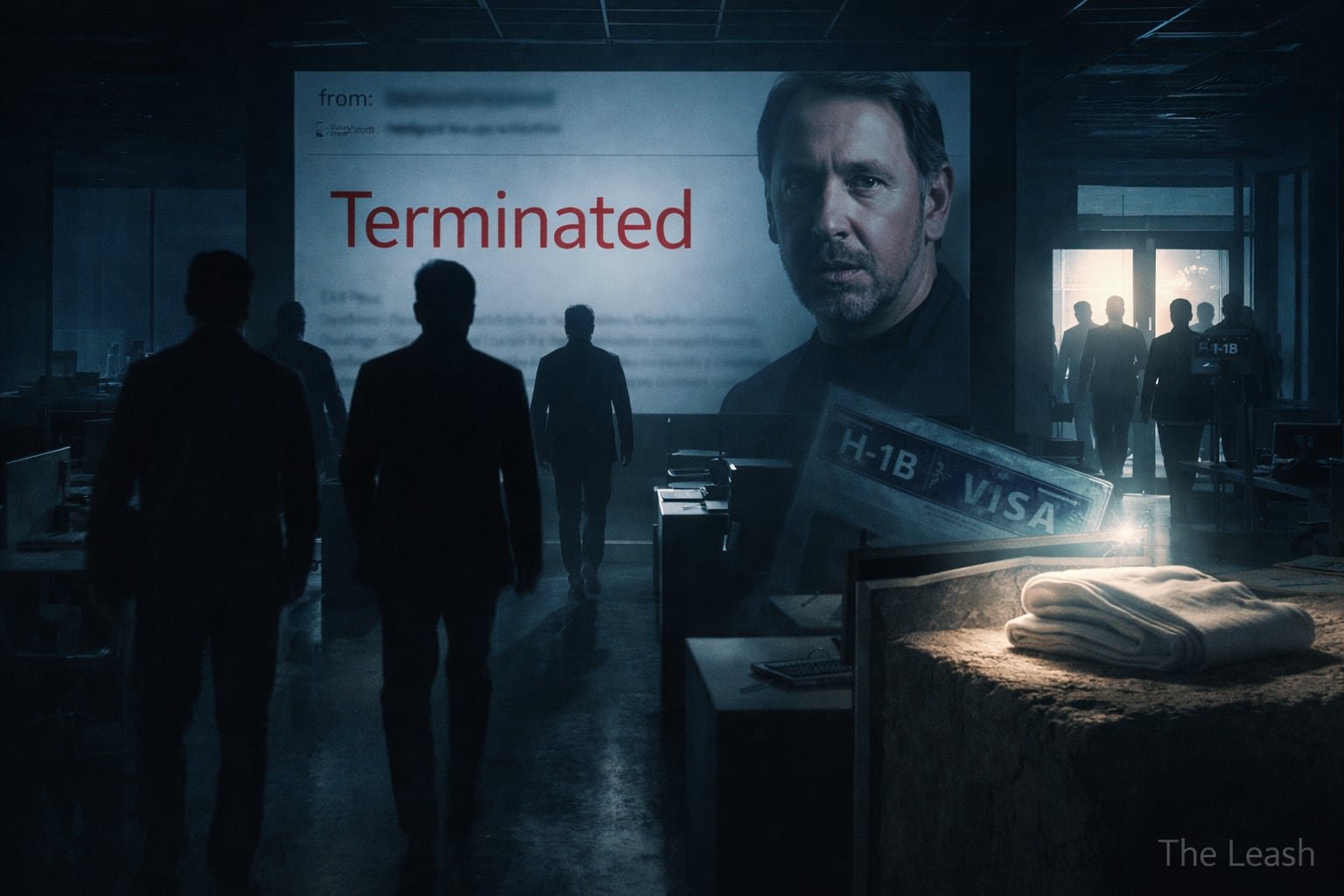

Oracle did not merely execute one of the largest workforce reductions in its history. It executed it with surgical precision while simultaneously filing thousands of H-1B visa petitions. On April 1, 2026, tens of thousands of employees woke up to a 6 a.m. email informing them of their immediate termination and revoking their system access. Hours later, USCIS data revealed that the company had filed 3,126 H-1B petitions for fiscal years 2025 and 2026. This is not coincidence. This is strategy.
The Explosive Timing: Mass Layoffs by Email and Visa Petitions
The cuts affected between 20,000 and 30,000 people globally, with direct impact inside the United States. The corporate message cited “organizational change” and “current business needs.” The reality is harsher: Oracle reported a 95 % surge in net profit and 22 % revenue growth. The layoffs were not driven by crisis. They were driven by margin expansion. While severing experienced employees with full negotiating power, the company filed thousands of applications to import labor legally bound to its payroll.
The H-1B Mechanism: The Leash That Binds the Foreign Worker
The H-1B visa, created in 1990 to address supposed talent shortages, has become the most efficient labor-control tool ever written into U.S. law. The foreign worker cannot change employers without losing legal status. They have 60 days to find a new sponsor or leave the country. They cannot negotiate wages freely. They cannot organize or threaten to quit. It is skilled labor – and, above all, compliant labor. Oracle did not hire scarce talent. It replaced workers who could leave with workers who legally cannot.
The Disney Precedent That Opened the Door
This is not new. In 2015 Disney forced 250 American IT workers to train their own H-1B replacements before receiving severance. The workers sued. A federal judge dismissed the case in 2016. Congress said nothing. That ruling became the HR playbook for every major U.S. corporation. Oracle simply opened the folder and scaled the model. The message is unambiguous: U.S. law permits the displacement of domestic labor as long as the H-1B paperwork is filed.
AI: The Narrative That Hides Wage Suppression
The official excuse is always the same: artificial intelligence, automation, efficiency. Oracle does not hide that part of the cuts fund AI investment. But AI does not file H-1B petitions. AI does not sign employment contracts. AI is not the actor displacing the American worker. Corporations are—using AI as the smokescreen to justify replacement by cheaper, less contentious labor. They told Americans that AI would take their jobs. In reality, AI is simply giving them the perfect alibi to do it themselves.
What This Means for the American Worker and the Future of Employment
Thirty-five years after its creation, the H-1B program no longer fills talent gaps. It is the most elegant labor-control mechanism ever codified in law. It allows corporations to pay less and demand greater loyalty. It allows the displacement of workers with full rights by workers with conditional rights. And it does so under the banner of innovation and global competitiveness. Meanwhile, the American worker receives the 6 a.m. email and watches their position filled by someone who cannot say no.
This is not an Oracle anecdote. It is the model spreading across the entire technology industry. While media repeat the “talent shortage” narrative, the data and the facts reveal a different reality: there is no shortage of talent. There is a shortage of willingness to pay the real price of American talent.
Sources
- New York Post (2026). Outrage as Oracle files thousands of foreign-worker visas amid layoffs. https://nypost.com/2026/04/02/us-news/outrage-over-oracles-thousands-of-h-1b-requests-amid-layoffs/
- Economic Times (2026). Oracle layoffs update: Amid thousands of job cuts, US IT firms’ big move triggers massive backlash online. https://m.economictimes.com/news/new-updates/oracle-layoffs-update-amid-thousands-of-job-cuts-us-it-firms-big-move-triggers-massive-backlash-online/articleshow/129994820.cms
- MarketWatch (2026). ‘Mass layoffs by email might be the new norm’ as Oracle fires thousands. https://www.marketwatch.com/story/fired-via-email-some-of-the-30-000-workers-cut-by-oracle-woke-up-to-a-morning-message-saying-they-were-laid-off-89a7af94 Economic Policy Institute (2015).
- Disney H-1B Scandal in Spotlight Again. https://www.epi.org/blog/disney-h1b-scandal-in-spotlight-meet-american-workers-whose-jobs-careers-were-destroyed/ SHRM (2016).
- Court Upholds Disney’s IT Outsourcing. https://www.shrm.org/topics-tools/employment-law-compliance/court-upholds-disneys-outsourcing