


A Deal That Exposes the Contradiction of “America First”
Trump landed in Beijing accompanied by America’s most powerful corporate elite in AI, chips, and finance. This is not a routine diplomatic trip. It is confirmation that, despite the rhetoric of tariffs and decoupling, American industry remains tied to Asian markets and supply chains. Far from reactivating the national industrial base, this summit reveals a structural dependence that Trump has failed to break.
America’s Tech Elite Pays Homage in Beijing
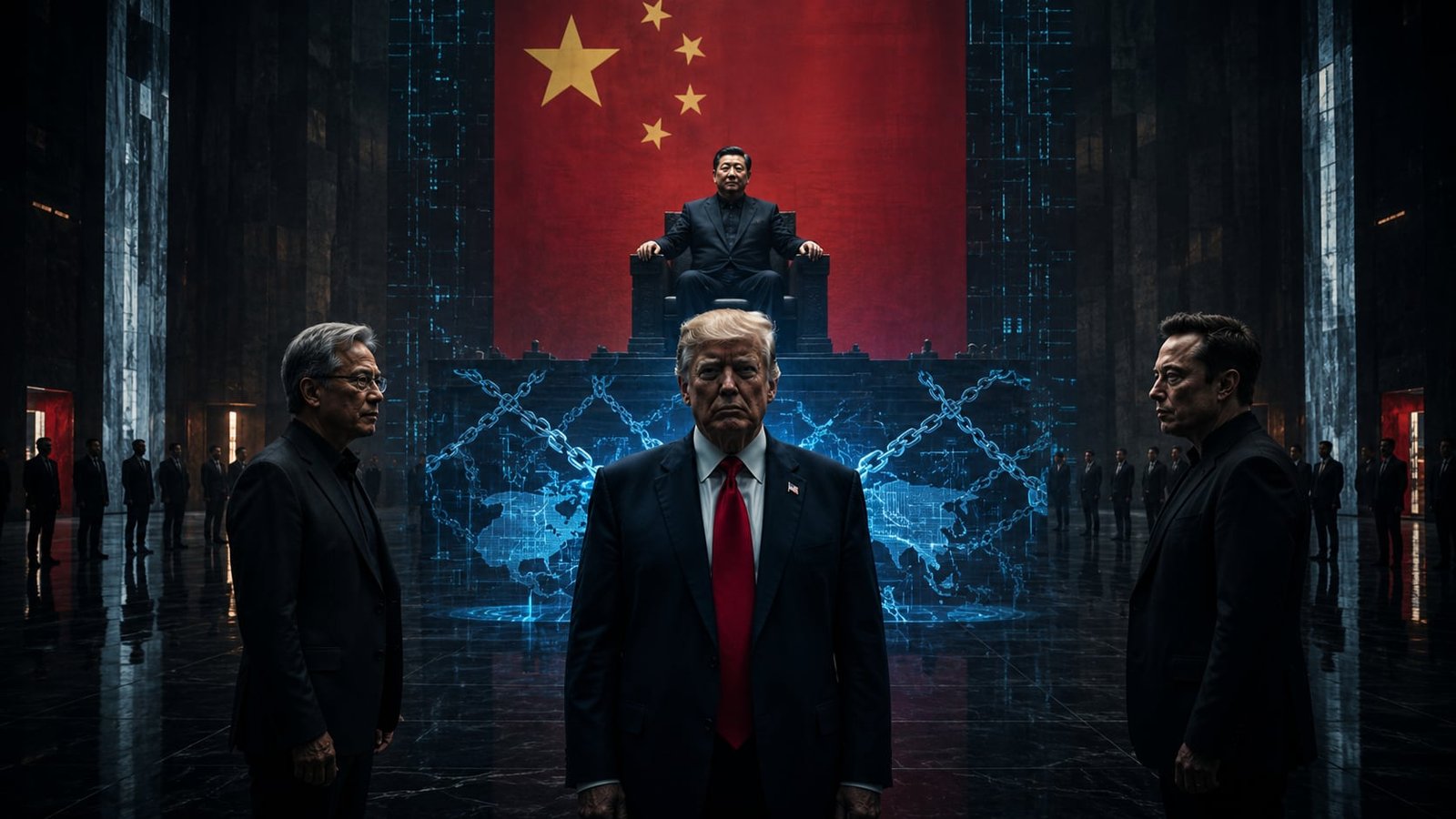
The delegation is explicit: Elon Musk (Tesla/SpaceX), Jensen Huang (Nvidia), Tim Cook (Apple), Larry Fink (BlackRock), Stephen Schwarzman (Blackstone), Kelly Ortberg (Boeing), and executives from Qualcomm, Micron, and GE Aerospace. These leaders do not travel as tourists. They represent the strategic sectors of the Fourth Industrial Revolution: AI, semiconductors, and aviation. Their massive presence at the summit with Xi Jinping proves that major U.S. companies need access to the Chinese market to sustain growth and profitability. Trump, who in his first term labeled China a “currency manipulator” and “intellectual property thief,” now presents them as partners in a “fantastic future.” The image does not lie: the president who promised to resurrect American manufacturing is negotiating directly with the leader who controls rare earths and critical supply chains for AI.
The Facts Disprove the Narrative of Industrial Victory
The tariffs of the first term did not significantly repatriate production. Chinese exports to the U.S. fell, but Beijing diversified toward Southeast Asia and Europe, consolidating its dominance in batteries, electric vehicles, and critical minerals. Now, amid the Iran war and Taiwan tensions, Trump seeks to stabilize trade to secure Boeing sales, agricultural purchases, and – above all – licenses for Nvidia’s AI chips. Jensen Huang joined the trip at the last minute precisely to push for resumed H200 chip sales to China. This is not industrial reactivation; it is an admission that America’s high-tech industry cannot thrive without the Chinese market or its components. “Decoupling” became selective “de-risking,” yet the reality is that CEOs travel to Beijing because the alternative – building everything on American soil – remains more expensive and slower.
The Fourth Industrial Revolution Cannot Be Built on Tariffs Alone
Here lies the strategic error this trip confronts: the “America First” promise collided with technological interdependence. China dominates rare earth processing essential for magnets, batteries, and semiconductors. Nvidia, Apple, and Tesla source critical components from chains Beijing controls. Bringing Musk and Huang is not negotiating genius; it is recognition that American AI superiority depends on Asian components and markets. Trump may celebrate spot “deals”- aircraft sales, farm purchases – but he does not alter the power structure: China continues massive investment in its own technological self-sufficiency while the U.S. negotiates access. This summit does not reactivate industry; it exposes its vulnerability.
The Geopolitical Cost of Dependence
Far from strengthening industrial sovereignty, this corporate rapprochement weakens Washington’s strategic position. Xi did not greet Trump at the airport; Beijing sets distances while receiving the CEOs who most need its market. The message is clear: China dictates the terms. For the Fourth Industrial Revolution, this means American AI -the engine of the next decade – will continue depending on a strategic rival. Trump is not “making America great again”; he is managing relative decline before an adversary that thinks in decades, not quarterly earnings.
Sources
- Reuters, May 11, 2026. “Elon Musk, Apple’s Cook and Boeing CEO going to China with Trump, official says”. https://www.reuters.com/world/asia-pacific/nvidia-ceo-huang-not-going-to-china-during-trump-visit-source-says-2026-05-11/
- The New York Times, May 11, 2026. “Chief Executives to Accompany Trump to China”. https://www.nytimes.com/2026/05/11/us/politics/trump-china-musk-cook.html
- BBC News, May 13, 2026. “Elon Musk and Jensen Huang among CEOs joining Trump on China trip”. https://www.bbc.com/news/articles/c5yx757w048o
- Council on Foreign Relations, May 10, 2026. “At the Trump-Xi Summit, China Will Have the Upper Hand”. https://www.cfr.org/articles/at-the-trump-xi-summit-china-will-have-the-upper-hand